The Surprising Link Between Chess and Math Grades (New Study Results)
By Lalit Akhade, Founder & Head Coach, ChessMates Academy · Published 2025-01-13 · 6 min read
Introduction: The Powerful Connection Between Chess and Mathematics
Mathematics and chess share a profound connection that educators and parents have recognized for centuries. Both disciplines require logical thinking, pattern recognition, and strategic problem-solving. For students struggling with math or those seeking to excel, chess offers an engaging pathway to mathematical mastery that feels more like play than study.
Research consistently demonstrates that children who learn chess show significant improvements in mathematical abilities. This isn't coincidental — chess naturally exercises the same cognitive muscles required for mathematical reasoning. From calculating piece values to visualizing geometric patterns on the board, every chess game is essentially a mathematical puzzle waiting to be solved.
In this comprehensive guide, we'll explore the fascinating relationship between chess and mathematics, backed by scientific research and practical insights that will help your child develop stronger math skills through the royal game.
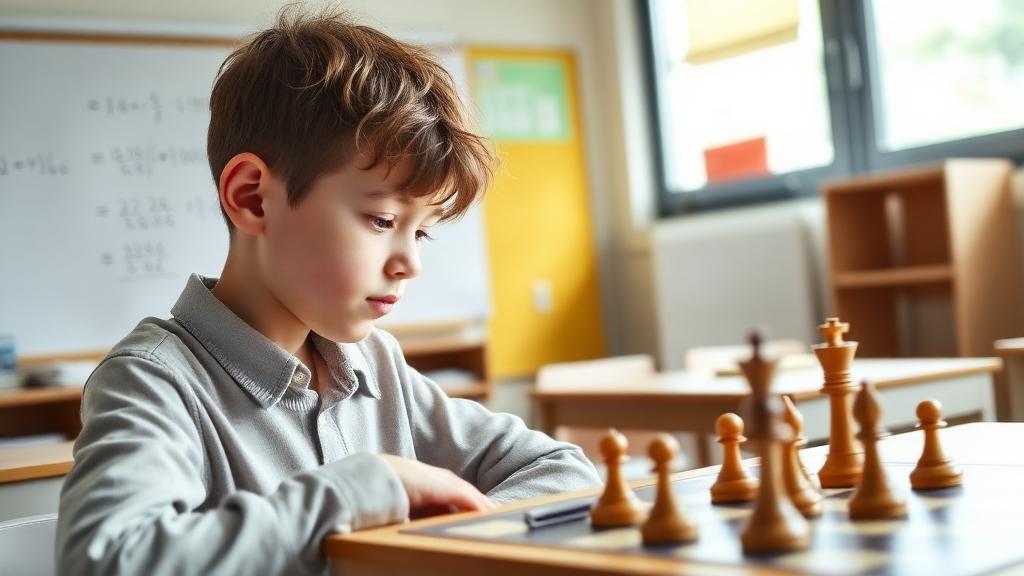
The Mathematical Foundation of Chess
Understanding Piece Values and Arithmetic
Chess introduces children to mathematical concepts from their very first lesson. Each piece has a numerical value — pawns are worth 1 point, knights and bishops approximately 3, rooks 5, and queens 9. Players constantly perform mental arithmetic to evaluate positions and make trading decisions.
This continuous calculation builds strong number sense. When a child considers whether to exchange a bishop for two pawns, they're performing mathematical comparison in a context that matters to them. Unlike abstract textbook problems, these calculations have immediate consequences in the game.
Geometry on the 64 Squares
The chessboard itself is a geometric masterpiece. The 64 squares arranged in an 8x8 grid teach concepts of:
- Coordinates: Using algebraic notation (a1, b2, c3) mirrors the coordinate systems used in mathematics
- Diagonals and perpendiculars: Bishop and rook movements illustrate geometric lines
- Symmetry: The starting position demonstrates perfect bilateral symmetry
- Area and perimeter: Understanding how pieces control squares relates to these concepts
Children who play chess develop stronger spatial reasoning, which directly correlates with success in geometry and advanced mathematics.
Pattern Recognition and Sequences
Mathematics is fundamentally about recognizing patterns, and chess is an endless source of patterns to discover:
- Opening patterns: Repeated sequences of moves that follow logical principles
- Tactical patterns: Forks, pins, and skewers that appear in countless games
- Endgame patterns: King and pawn endings follow mathematical rules
This pattern recognition transfers directly to mathematical learning, where students must identify sequences, progressions, and relationships between numbers.
Scientific Research: Chess and Mathematical Achievement
Landmark Studies on Chess and Math
Multiple research studies have validated the chess-mathematics connection:
The Venezuelan Study (1988): Over 4,000 students were taught chess systematically. After just one year, significant improvements were measured in mathematical problem-solving abilities compared to control groups.
The Texas Study (1998): Students who participated in chess instruction showed marked improvements in both math and reading scores on standardized tests.
The Italian Study (2012): Researchers found that children who learned chess demonstrated superior mathematical abilities, particularly in problem-solving tasks requiring multiple steps.
Why Chess Improves Math Performance
The cognitive mechanisms behind this improvement include:
- Enhanced working memory: Chess requires holding multiple possibilities in mind simultaneously
- Improved executive function: Planning moves develops the same brain regions used for mathematical reasoning
- Increased attention span: Chess trains sustained concentration needed for complex math problems
- Developed metacognition: Players learn to evaluate their thinking, a skill essential for mathematical self-correction
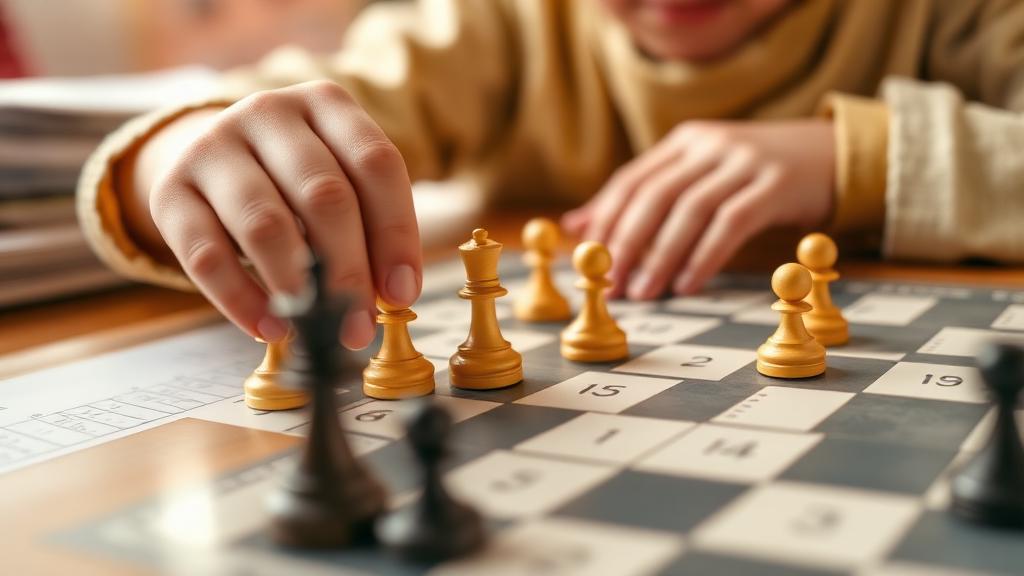
Specific Mathematical Skills Developed Through Chess
Computational Thinking
Chess naturally develops computational thinking — the ability to break down complex problems into manageable steps. When analyzing a position, players must:
- Identify the key elements of the problem
- Consider possible solutions systematically
- Evaluate the consequences of each option
- Select the optimal approach
This process mirrors mathematical problem-solving at every level, from basic arithmetic to advanced calculus.
Logical Reasoning
Every chess move is an exercise in logical reasoning. "If I move here, then my opponent will likely respond there, which means I should..." This if-then thinking is the foundation of mathematical proof and logical argumentation.
Children learn to: - Form and test hypotheses - Draw logical conclusions from given information - Recognize invalid reasoning (both their own and their opponent's mistakes) - Build chains of logical deduction
Probability and Risk Assessment
Advanced chess players constantly assess probabilities:
- What are the chances my opponent sees this tactic?
- Which continuation is most likely to succeed?
- What's the risk-reward ratio of this sacrifice?
While not formal probability calculations, these assessments build intuitive understanding of mathematical likelihood that supports later formal study.
Abstract Thinking
Chess develops comfort with abstraction — pieces become symbols, positions become patterns, and games become representative of broader principles. This abstraction ability is essential for algebraic thinking, where letters represent unknown quantities.
How Parents Can Maximize the Chess-Math Connection
Integrating Chess and Math at Home
Parents can strengthen the connection between chess and mathematics:
During games: Ask mathematical questions like "How many squares does your rook control?" or "If I trade my bishop for your knight, who gains material?"
After games: Review positions and count possibilities. "How many legal moves did you have in this position?"
Through puzzles: Chess puzzles are mathematical problems in disguise. Set a timer and treat them like math exercises.
Creating a Learning Environment
- Keep a chessboard near the homework area
- Use chess examples to illustrate math concepts
- Celebrate both chess victories and math achievements
- Show how chess thinking applies to school problems
Choosing the Right Instruction
Not all chess programs emphasize the mathematical connection. Look for instruction that:
- Explicitly connects chess concepts to mathematical thinking
- Uses proper notation and numerical language
- Encourages analytical discussion of positions
- Provides problem-solving exercises alongside game play
Chess at Different Mathematical Levels
Elementary School Mathematics
For young learners, chess supports:
- Counting and number recognition
- Basic addition and subtraction (material counting)
- Introduction to coordinates
- Pattern recognition fundamentals
- Spatial awareness
Middle School Mathematics
As students advance, chess develops:
- More complex calculations
- Geometric understanding
- Basic probability concepts
- Multi-step problem solving
- Abstract thinking preparation
High School and Beyond
Advanced students benefit from chess through:
- Complex calculation sequences
- Advanced spatial reasoning
- Decision theory concepts
- Risk assessment skills
- Strategic planning abilities
The Role of Chess in STEM Education
Chess is increasingly recognized as a STEM-supporting activity. The systematic thinking and problem-solving approaches mirror those used in:
- Science: Hypothesis testing and observation
- Technology: Algorithmic thinking and systematic analysis
- Engineering: Design thinking and optimization
- Mathematics: All forms of mathematical reasoning
Many schools now incorporate chess into STEM curricula, recognizing its value for developing the next generation of scientists, engineers, and mathematicians.
Success Stories: From Chess to Mathematical Excellence
Many successful mathematicians and scientists were chess players:
- Emanuel Lasker: World chess champion and mathematician who contributed to algebra and game theory
- John Nunn: Grandmaster and mathematician who excels in both fields
- Numerous engineers and scientists: Report that chess helped develop their analytical abilities
While not every chess player becomes a mathematician, the thinking skills transfer powerfully between domains.
Practical Tips for Building Math Skills Through Chess
Daily Practice Recommendations
- 15 minutes of puzzles: Tactical problems exercise calculation
- One analyzed game weekly: Deep analysis builds systematic thinking
- Regular online play: Apply skills in real-time situations
- Discussion with parents or coaches: Verbalize mathematical thinking
Tracking Progress
Monitor both chess and mathematical improvement:
- Chess rating changes
- Math test scores
- Problem-solving speed
- Logical reasoning assessments
Often, improvements appear in chess first before transferring to academic mathematics.
How Chessmates.in Develops Mathematical Thinking
Chessmates.in specifically designs instruction to maximize the chess-math connection:
- Structured problem-solving lessons: Mathematical thinking is explicitly developed
- Numerical analysis exercises: Students learn to evaluate positions quantitatively
- Pattern recognition training: Transferable skills are emphasized
- Progress tracking: Parents see mathematical skill development alongside chess improvement
Our certified instructors understand both chess and educational theory, ensuring maximum benefit for your child's mathematical development.
FAQs About Chess and Mathematics
1. At what age should children start chess for math benefits? Children as young as 5 can begin, with benefits increasing as they develop. Starting early builds strong foundations, but benefits occur at any age.
2. How long until I see math improvements from chess? Most studies show measurable improvements within 6-12 months of regular chess instruction, though individual results vary.
3. Can chess help children who struggle with math? Yes! Chess provides an engaging, low-pressure way to develop mathematical thinking for students who find traditional instruction challenging.
4. Should chess replace math homework? No — chess complements rather than replaces mathematics education. The two together create powerful synergy.
5. Do I need to be good at math to teach my child chess? Not at all! Focus on the game itself, and the mathematical benefits will develop naturally through play.
Conclusion: Chess as a Mathematical Investment
Teaching your child chess is one of the most effective investments you can make in their mathematical future. The skills developed — logical reasoning, pattern recognition, calculation, and strategic thinking — form the foundation for mathematical success at every level.
Unlike drill-based math practice, chess provides intrinsic motivation. Children want to improve because the game is inherently engaging. This self-directed learning, combined with the cognitive benefits, makes chess uniquely powerful for mathematical development.
At Chessmates.in, we help children unlock their mathematical potential through expert chess instruction. Our programs are designed to develop thinking skills that transfer directly to academic success.
Start your child's journey to mathematical excellence through chess today. The 64 squares hold infinite possibilities for learning, growth, and achievement.